


Eintrittsmissionen in die Atmosphäre von Planeten sowie anderen Himmelskörpern stellen zukünftige Ziele in der Raumfahrt dar, die nur mit verbessertem Wissen um das Verhalten, die Eigenschaften und die Auswirkungen der Strömung um ein Raumfahrzeug sicher durchgeführt werden können. Des Weiteren gewinnt beim Design von fortschrittlichen Raumfahrttriebwerken ein fundiertes Wissen über das Verhalten des Abgasstrahls der Triebwerke an Bedeutung. Mit numerischen Verfahren können Strömungen simuliert werden, bei denen in aller Regel die Möglichkeiten, geeignete Experimente durchzuführen, stark eingeschränkt oder mit hohen Kosten verbunden sind. Daher kommt den numerischen Untersuchungsmethoden eine immer stärker werdende Bedeutung zu.

Einen Schwerpunkt der Arbeitsgruppe Numerische Modellierung und Simulation stellt dabei die Modellierung von Nicht-Gleichgewichtseffekten bei Gasen und Plasmen dar. Diese treten immer dann auf, wenn es zu großen lokalen Unterschieden der Umgebungsbedingungen kommt, zum Beispiel bei großen Temperaturunterschieden. Beispiele aus der Raumfahrt wurden mit Eintrittsmissionen oder Raumfahrtantrieben bereits genannt. Allerdings ist das Verständnis dieser Effekte auch in anderen industriellen Bereichen zunehmend wichtig. Das Spektrum reicht dabei von Micro- und Nanotechnologie inklusive plasmabasierter Beschichtungsprozesse zur Nanotechnologieherstellung selbst bis hin zur Next-Generation-Lithografie.
Im Rahmen einer Kooperation zwischen dem Institut für Raumfahrtsysteme (IRS) und dem Institut für Aerodynamik und Gasdynamik (IAG) wurde „PICLas“ als flexibles Simulationswerkzeug zur Berechnung dreidimensionaler Gas- und Plasmaströmungen entwickelt. Mittlerweile konnte sich die Firma „boltzplatz“ als eine Universitätsausgründung ehemaliger Mitarbeiter der Numerikabteilungen von IRS und IAG auf Basis von PICLas etablieren. Dies sorgt für einen direkten Austausch zwischen Industrie und Universität sowie eine immer weiter wachsende Anwenderzahl von PICLas auch außerhalb universitärer Einrichtungen. Mehr Informationen und Kontaktmöglichkeiten sind auf der boltzplatz-Webseite zu finden.

PICLas koppelt verschiedene Feld- und Partikellöser, um in verschiedenen Gas- und Plasmaregimes numerisch effiziente Lösungsverfahren bereitstellen zu können. Historisch gesehen startete PICLas als Tool zur Simulation verdünnter Gase und Plasmen, weshalb die zwei größten Module in PICLas derzeit Particle-In-Cell (PIC) und Direct Simulation Monte Carlo (DSMC) sind. Während das PIC-Modul die elektromagnetischen Wechselwirkungen von Partikeln in Plasmen modelliert, bildet das DSMC-Modul die Kollisionen und die dabei ablaufenden chemischen Reaktionen in neutralen Strömungen sowie in Plasmaströmungen nach. Beide Methoden werden schon seit vielen Jahren in einem weiten Feld numerischer Untersuchungen eingesetzt und am IRS weiterentwickelt und optimiert.
Eine andere Entwicklung von PICLas beschäftigt sich mit der numerischen Untersuchung von Strömungen und Plasmen im Rahmen von Multiskalenphänomenen. Dies beinhaltet z.B. extrem große Dichtegradienten, wie sie in Düsenexpansionen vorkommen. Ein anderes Beispiel sind große zeitliche Gradienten von den in der Strömung vorkommenden physikalischen Effekten. So können die Zeitskala der Plasmaoszillation und die Zeitskalen der Advektion von Ionen, die in elektrischen Raumfahrtantrieben relevant sind, mehrere Größenordnungen auseinanderliegen. Hierzu werden verschiedene Partikelkontinuumsmethoden wie die Bhatnagar-Gross-Krook- (BGK) oder die Fokker-Planck-Methode (FP) mit PIC und DSMC gekoppelt. Zusätzlich werden verschiedene implizite Verfahren entwickelt, um die Effektivität der Methoden weiter zu erhöhen.
Des Weiteren spielen bei einigen der zu untersuchenden Strömungen Strahlungseffekte eine bedeutende Rolle. Daher beschäftigt sich die Arbeitsgruppe gesondert auch mit der Weiterentwicklung von Strahlungslösern.
Verschiedene Anwendungen simuliert mit PICLas
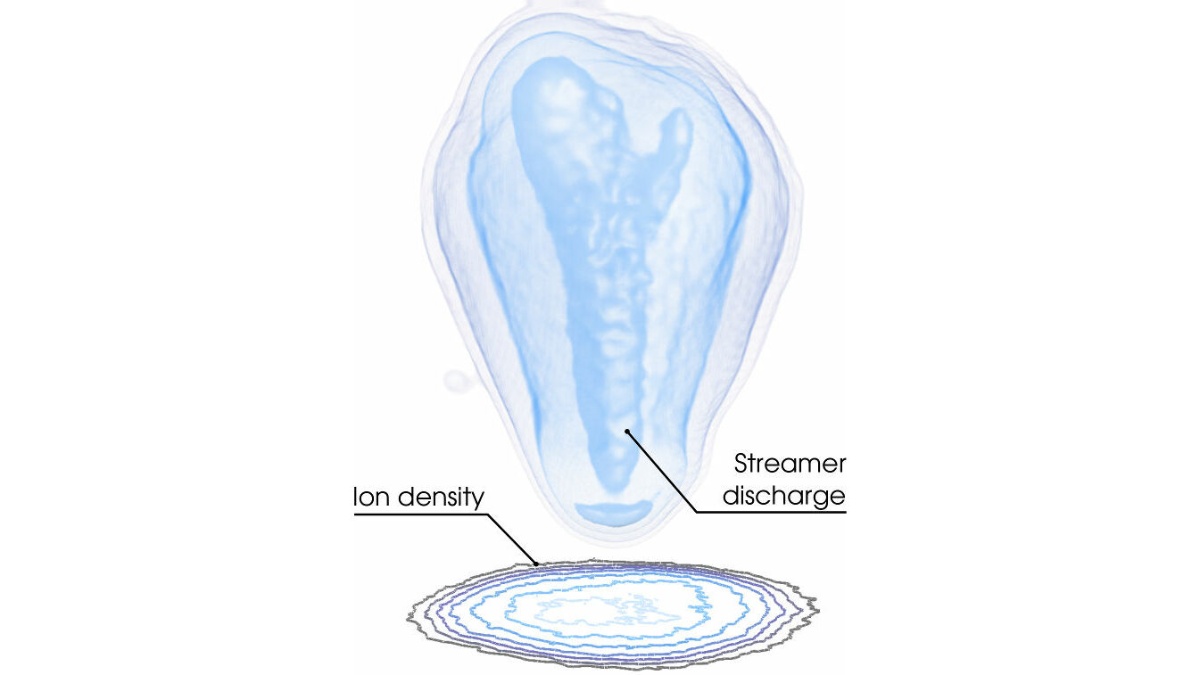
Streamerbildung in einer Zündkerze
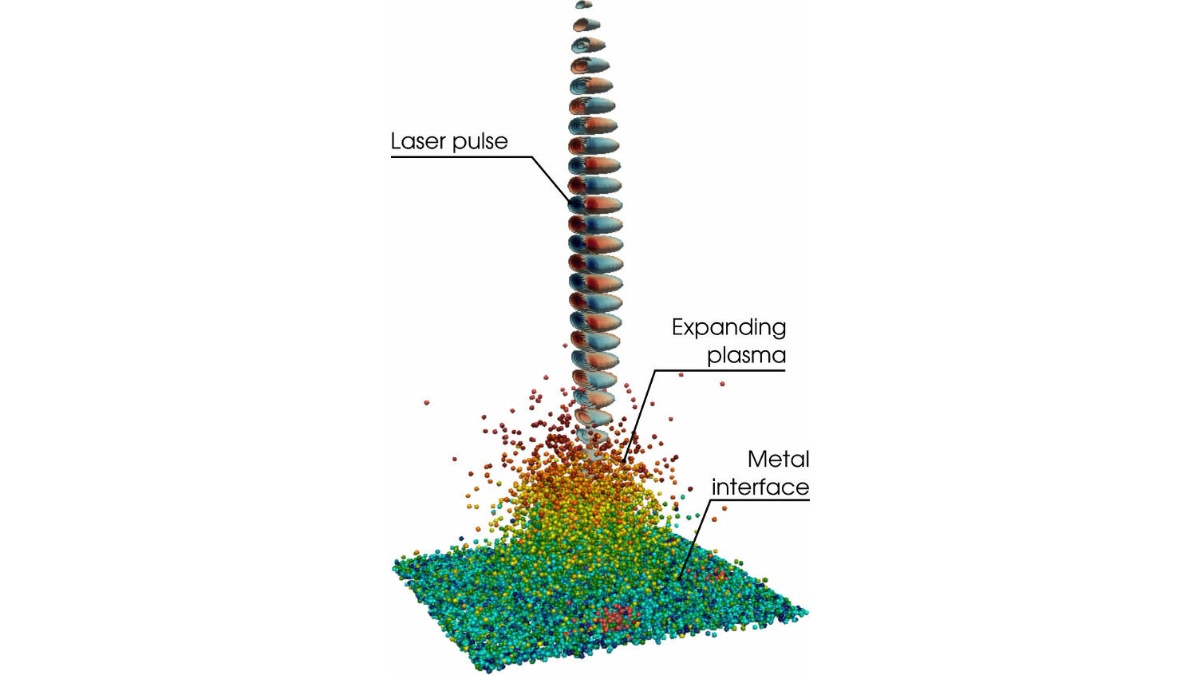
Laser-Plasma-Interaktion

Eintritt in die Titan-Atmosphäre
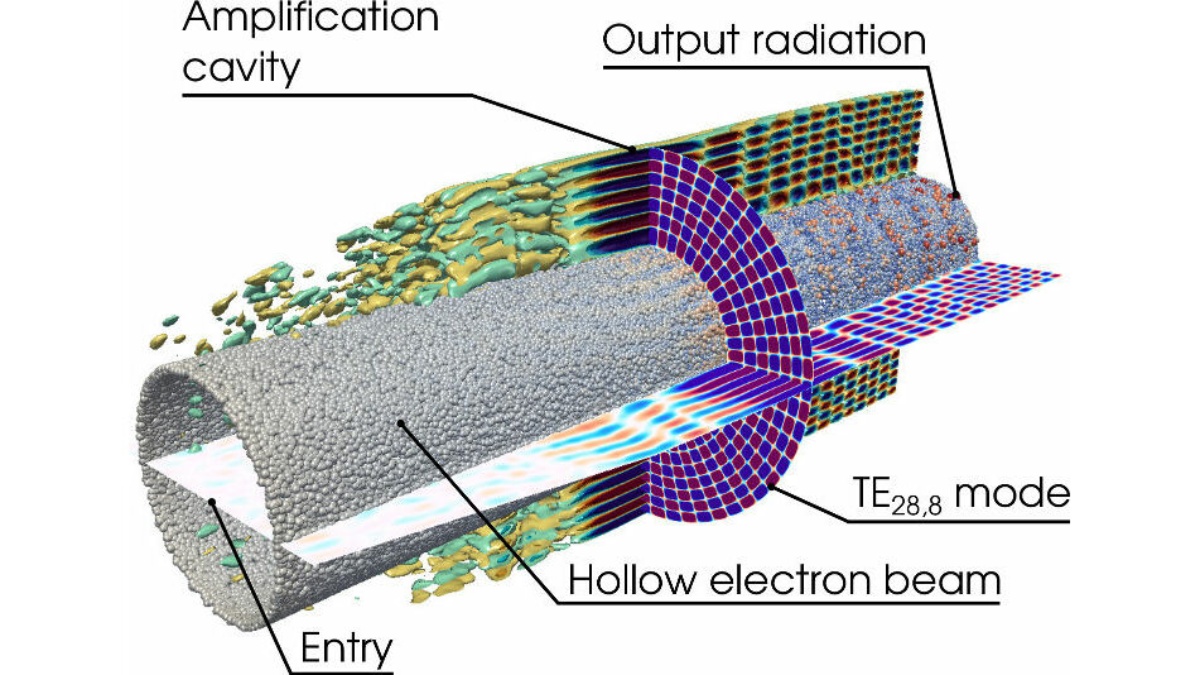
Gyrotron-Mikrowellengenerator
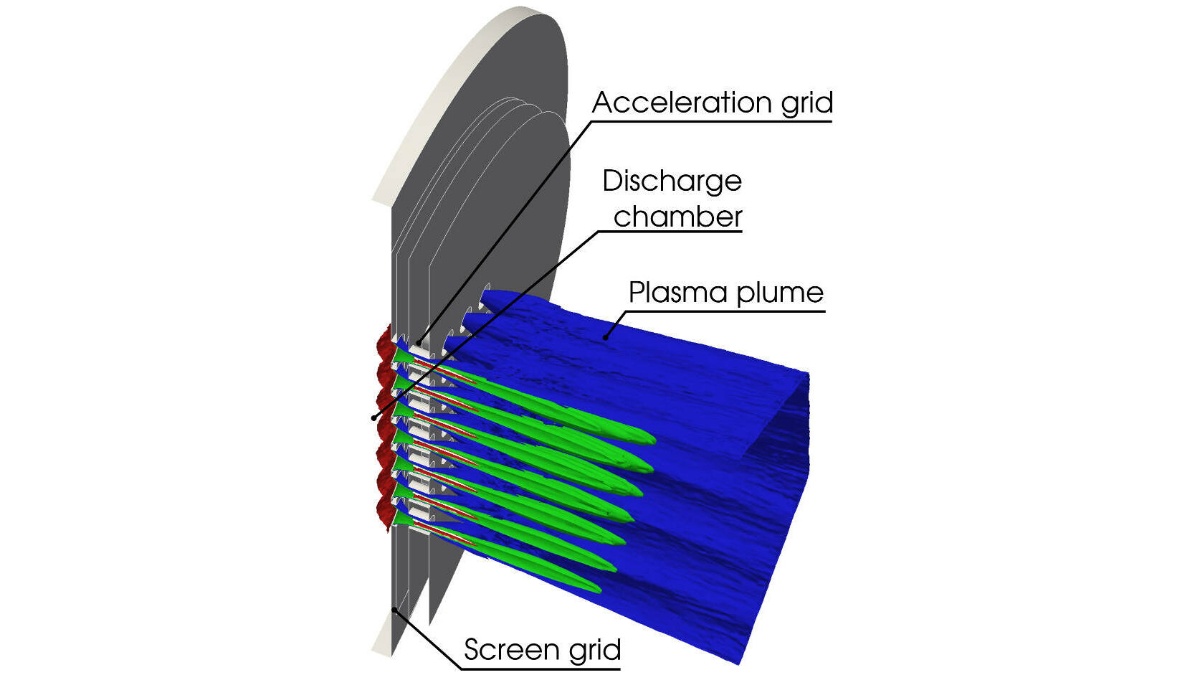
Ionentriebwerk
Aktuelle Projekte
Der Sonderforschungsbereich (SFB) 1667 „ATLAS - Fortschrittliche Technologien für Satelliten in sehr geringer Höhe“ befasst sich mit den wissenschaftlichen und technischen Herausforderungen für die Erschließung von sehr niedrigen Erdumlaufbahnen (VLEO, etwa 200 km bis 450 km Höhe). Die Numerik-Gruppe entwickelt innerhalb ATLAS ein detaillierteres Gas-Oberflächen-Wechselwirkungsmodell und führt numerische Untersuchungen von VLEO‑Testanlagen durch.
Kürzlich abgeschlossene Projekte

Ziel ist die Entwicklung partikelbasierter Multiskalenmethoden für thermo-chemische Nichtgleichgewichtsgas- und Plasmaströmungen, die erstmals die Simulation einer Vielzahl von High-Tech-Anwendungen ermöglichen.
DROPIT ist ein Graduiertenkolleg, das sich mit der Untersuchung von Tröpfcheninteraktionsphänomenen befasst. Ziel ist es, zu verstehen, wie mikroskalige Transportprozesse die makroskopischen Strömungseigenschaften beeinflussen.
Numerische Methoden
Stochastische Partikelverfahren sind der Schwerpunkt der Numerikgruppe am IRS. Sie bieten vor allem bei höherdimensionalen Problemen wie der Lösung der Boltzmanngleichung oft Vorteile.
Die Entwicklung von Rauschunterdrückungsverfahren für stochastische Partikelmethoden ist für langsame bzw. Low-Mach-Strömungen von großer Bedeutung.
Beim Eintritt in die Atmosphäre sind Raumfahrzeuge einer Strömung mit hoher Enthalpie ausgesetzt, die zur Ionisation und Anregung der inneren Freiheitsgrade von Atomen und Molekülen führt. Die daraus resultierende Strahlung beeinflusst den Wärmestrom an der Oberfläche erheblich. Das Strahlungsmodul von PICLas verwendet eine Monte-Carlo-Methode, um die Energieübertragung in komplexen Geometrien genau zu berechnen und präzise Wärmestromvorhersagen zu gewährleisten.
Hitzeschutzschilde sind unerlässlich für den atmosphärischen Raumfahrzeugeintritt. Die Materialwahl ist entscheidend für Extrembedingungen und Gewichtsminimierung. Heterogene Prozesse zwischen Gas und Oberfläche beeinflussen dabei den Wärmefluss. Ein katalytisches Reaktionsmodell in PICLas schätzt diesen Einfluss ab, da Experimente kostenintensiv sind.
Die sehr niedrige Erdumlaufbahn (Very Low Earth Orbit, VLEO), typischerweise definiert als Höhen unter 450 km, bietet einzigartige Herausforderungen und Möglichkeiten für Satellitenmissionen. Einer der kritischen Aspekte des Betriebs in VLEO ist das Verständnis der Wechselwirkungen zwischen Gas und Oberfläche, die sich erheblich auf die Konstruktion und den Betrieb von Satelliten auswirken.
Partikelbasierte Mehrphasenmethoden bieten eine effiziente Möglichkeit, Nichtgleichgewichtseffekte in Mehrphasenströmungen darzustellen.
Plasmaeffekte spielen bei hochenthalpen Strömungen eine große Rolle. Mit der Particle-In-Cell-Methode sollen deshalb Nicht-Gleichgewichtseffekte in Plasmen simuliert werden.
Plasma Kinetic Code PICLas
Alle Modelle, die innerhalb der Numerikgruppe entwickelt werden, sind auf GitHub im Open Source-Code PICLas verfügbar. Zusätzlich ist eine ausführliche Dokumentation auf piclas.readthedocs.io zu finden.

Forschung
Dr.-Ing. Marcel Pfeiffer
Gruppenleitung, Leitung ERC Starting Grant MEDUSA
Tel. +49 (0)711 685-60335
Mail: mpfeiffer@irs.uni-stuttgart.de
Franziska Tuttas, M. Sc.
Modellierung von Gasgemischen im Nichtgleichgewicht
Tel. +49 (0)711 685-62051
Mail: tuttasf@irs.uni-stuttgart.de
Miklas Schütte, M. Sc.
Gas-Oberflächen-Interaktionen im VLEO
Tel. +49 (0)711 685-65860
Mail: schuettem@irs.uni-stuttgart.de
Kim-Sophie Ellenberger, M. Sc.
Numerische Untersuchung von VLEO-Testanlagen
Tel. +49 (0)711 685-60359
Mail: ellenbergerk@irs.uni-stuttgart.de
Publikationen
2026
- 1. N. Barth et al., “PICLas-Based Intake Simulation Activities for the Development of an ABEP Specular Intake,” in Rarefied Gas Dynamics, M. Grabe, G. Oblapenko, and M. Torrilhon, Eds., Cham: Springer Nature Switzerland, 2026, pp. 203–211. doi: https://doi.org/10.1007/978-3-032-00094-1_20.
- 2. C. H. B. Civrais, M. Pfeiffer, C. White, and R. Steijl, “Vibronic Modelling in Direct Simulation Monte Carlo,” in Rarefied Gas Dynamics, M. Grabe, G. Oblapenko, and M. Torrilhon, Eds., Cham: Springer Nature Switzerland, 2026, pp. 531–539.
- 3. F. Garmirian and M. Pfeiffer, “Combining Stochastic Particle BGK and Discrete Velocity Method for Efficient Multiscale Simulations,” in Rarefied Gas Dynamics, M. Grabe, G. Oblapenko, and M. Torrilhon, Eds., Cham: Springer Nature Switzerland, 2026, pp. 481–489.
- 4. S. Lauterbach, F. Tuttas, and M. Pfeiffer, “A harmonically coupled-anharmonic-oscillator approach for polyatomic chemistry modeling in DSMC,” The Journal of Chemical Physics, Oct. 2026, doi: 10.1063/5.0350361.
- 5. S. Lauterbach, S. Fasoulas, and M. Pfeiffer, “Adaptive Particle Discretization Methods for Multiscale Non-equilibrium Flows,” in Rarefied Gas Dynamics, Cham: Springer Nature Switzerland, 2026, pp. 629–637.
- 6. T. Ott, H. Gorji, and M. Pfeiffer, “An Improved Particle Scheme for Solving Fokker-Planck Models of the Boltzmann Equation,” in Rarefied Gas Dynamics, M. Grabe, G. Oblapenko, and M. Torrilhon, Eds., Cham: Springer Nature Switzerland, 2026, pp. 491–500.
- 7. M. Schütte, S. Hocker, H. Lipp, J. Roth, S. Fasoulas, and M. Pfeiffer, “Conditional normalizing flow for gas–surface scattering from thermal to hypersonic velocities,” Physics of Fluids, vol. 38, Art. no. 9, 2026, doi: 10.1063/5.0350421.
- 8. M. Schütte, I. Hörner, S. Löhle, S. Fasoulas, and M. Pfeiffer, “Numerical Simulation of the Flow Field Around a Sounding Rocket for the PMWE Project,” in Rarefied Gas Dynamics, M. Grabe, G. Oblapenko, and M. Torrilhon, Eds., Springer Nature Switzerland, 2026, pp. 193–201.
- 9. F. Tuttas and M. Pfeiffer, “Comparison of Stochastic BGK and FP Methods for the Simulation of Non-Equilibrium Multi-species Molecular Gas Flows,” in Rarefied Gas Dynamics, M. Grabe, G. Oblapenko, and M. Torrilhon, Eds., Cham: Springer Nature Switzerland, 2026, pp. 421–429. doi: 10.1007/978-3-032-00094-1_40.
2025
- 10. N. Barth et al., “Solar activity dependency of a specular intake for an ABEP system,” Journal of electric propulsion, vol. 4, p. 57, 2025, doi: 10.1007/s44205-025-00157-7.
- 11. C. H. B. Civrais, M. Pfeiffer, C. White, and R. Steijl, “Development of a chemistry model for vibronically excited species in direct simulation Monte Carlo,” Physics of fluids, vol. 37, Art. no. 10, 2025, doi: 10.1063/5.0295298.
- 12. K.-S. Ellenberger, A. Schlitzer, M. Pfeiffer, and S. Fasoulas, “Numerical Study on the Setup of an Atomic Oxygen Ground Testing Facility,” in 3rd International Conference on Flight Vehicles, Aerothermodynamics and Re-entry (FAR), May 2025. [Online]. Available: https://www.researchgate.net/publication/393786584_NUMERICAL_STUDY_ON_THE_SETUP_OF_AN_ATOMIC_OXYGEN_GROUND_TESTING_FACILITY
- 13. F. Garmirian and M. Pfeiffer, “Implementation of asymptotic preserving discrete velocity methods into the simulation code PICLas,” Computer physics communications, vol. 314, Art. no. September, 2025, doi: 10.1016/j.cpc.2025.109648.
- 14. S. Lauterbach, S. Fasoulas, and M. Pfeiffer, “Modeling of heterogeneous catalytic reactions with the simulation tool PICLas,” Computer physics communications, vol. 311, p. 109560, 2025, doi: 10.1016/j.cpc.2025.109560.
- 15. T. Ott and M. Pfeiffer, “Coupled PIC-DSMC Simulation of Hypersonic Reentry Flows with Ionization,” in 3rd International Conference on Flight Vehicles, Aerothermodynamics and Re-entry (FAR), 2025.
- 16. M. Pfeiffer, F. Garmirian, and T. Ott, “Crank-Nicolson Bhatnagar-Gross-Krook integrator for multiscale particle-based kinetic simulations,” Physics of fluids, vol. 37, Art. no. 2, 2025, doi: 10.1063/5.0251345.
- 17. M. Schütte, S. Hocker, H. Lipp, J. Roth, S. Fasoulas, and M. Pfeiffer, “A machine learning framework for scattering kernel derivation using molecular dynamics data in very low Earth orbit,” Physics of Fluids, Sep. 2025, doi: 10.1063/5.0287359.
- 18. M. Schütte, S. Fasoulas, and M. Pfeiffer, “Enhanced gas-surface scattering modeling for VLEO satellites in DSMC simulations,” CEAS Space Journal, Jun. 2025, doi: 10.1007/s12567-025-00629-4.
- 19. R. Tietz, R. Stierle, K. S. Ellenberger, S. Fasoulas, and M. Pfeiffer, “A Multi-Species Enskog-Vlasov Solver to Determine Evaporation Coefficients of Fluids in High Pressure Environments.” arXiv, 2025. doi: 10.48550/ARXIV.2506.22162.
- 20. F. Turco, C. Traub, M. Schütte, M. Pfeiffer, and S. Fasoulas, “Assessment of the Practicality of Optimal Aerodynamic Orbit Control in VLEO,” in IAF Astrodynamics Symposium : held at the 76th International Astronautical Congress (IAC 2025) : Sydney, Australia, 29 September-3 October 2025, Curran Associates, Inc., 2025, pp. 312–325. doi: 10.52202/083087-0029.
- 21. F. Tuttas and M. Pfeiffer, “Modeling of Particle-Based BGK Methods for the Simulation of Chemically Reactive Gas Mixtures in Multi-Scale Flows,” May 2025. [Online]. Available: https://www.researchgate.net/publication/391316219_Modeling_of_Particle-Based_BGK_Methods_for_the_Simulation_of_Chemically_Reactive_Gas_Mixtures_in_Multi-Scale_Flows
- 22. F. Tuttas and M. Pfeiffer, “Multi-Scale Gas Kinetic Simulations for Chemically Reactive Flows.” 22nd International Planetary Probe Workshop, 2025. doi: 10.13140/RG.2.2.16441.28000.
2024
- 23. J. Beyer, P. Nizenkov, S. Fasoulas, and M. Pfeiffer, “Simulation of Radiating Non-equilibrium Flows around a Capsule Entering Titan′s Atmosphere,” in 32nd International Symposium on Rarefied Gas Dynamics, R. S. Myong, K. Xu, and J.-S. Wu, Eds., in AIP Conference Proceedings. American Institute of Physics, 2024, p. 200002. doi: 10.1063/5.0187531.
- 24. C. H. B. Civrais, M. Pfeiffer, C. White, and R. Steijl, “Modeling of the electronic excited states in high-temperature flows,” Physics of fluids, vol. 36, Art. no. 8, 2024, doi: 10.1063/5.0215853.
- 25. F. Garmirian, H. Gorji, and M. Pfeiffer, “Exponential BGK Integrator for Multiscale Flow Simulation,” in 32nd International Symposium on Rarefied Gas Dynamics, R. S. Myong, K. Xu, and J.-S. Wu, Eds., in AIP Conference Proceedings. American Institute of Physics, 2024, p. 60005. doi: 10.1063/5.0187429.
- 26. G. Herdrich et al., “System design study of a VLEO satellite platform using the IRS RF helicon-based plasma thruster,” Acta Astronautica, Feb. 2024, doi: 10.1016/j.actaastro.2023.11.009.
- 27. F. Hild and M. Pfeiffer, “Multi-species modeling in the particle-based ellipsoidal statistical Bhatnagar-Gross-Krook method including internal degrees of freedom,” Journal of Computational Physics, vol. 514, p. 113226, 2024, doi: 10.1016/j.jcp.2024.113226.
- 28. F. Hild and M. Pfeiffer, “Simulation of Multi-species Non-equilibrium Gas Flows with the Particle-based Ellipsoidal Statistical Bhatnagar-Gross-Krook Method,” in 32nd International Symposium on Rarefied Gas Dynamics, R. S. Myong, K. Xu, and J.-S. Wu, Eds., in AIP Conference Proceedings, vol. 2996. American Institute of Physics, 2024, p. 60001. doi: 10.1063/5.0187423.
- 29. S. Lauterbach, S. Fasoulas, and M. Pfeiffer, “Surface Chemistry Modeling ith the SimulationTool PICLas,” in 32nd International Symposium on Rarefied Gas Dynamics, R. S. Myong, K. Xu, and J.-S. Wu, Eds., in AIP Conference Proceedings, vol. 2996. American Institute of Physics, 2024, p. 80011. doi: 10.1063/5.0187425.
- 30. C. Marianowski, C. Traub, M. Pfeiffer, J. Beyer, and S. Fasoulas, “Satellite design optimization for differential lift and drag applications,” CEAS space journal, 2024, doi: 10.1007/s12567-024-00550-2.
- 31. M. Pfeiffer et al., “Numerical simulation of an iron meteoroid entering into Earth’s atmosphere using DSMC and a radiation solver with comparison to ground testing data,” Icarus, vol. 407, p. 115768, 2024, doi: 10.1016/j.icarus.2023.115768.
- 32. R. Tietz, S. Fasoulas, and M. Pfeiffer, “Symmetric Simulations of Droplets with a Particle based Vlasov-Enskog-Solver,” in 32nd International Symposium on Rarefied Gas Dynamics, R. S. Myong, K. Xu, and J.-S. Wu, Eds., in AIP Conference Proceedings. American Institute of Physics, 2024, p. 120002. doi: 10.1063/5.0187426.
2023
- 33. F. Garmirian and M. Pfeiffer, “Exponential Differencing BGK Method for Multiscale Flow Simulation,” 2023, doi: 10.13009/EUCASS2023-615.
- 34. T. Ott and M. Pfeiffer, “PIC schemes for multi-scale plasma simulations,” 2023, doi: 10.13009/EUCASS2023-770.
2022
- 35. J. Beyer, M. Pfeiffer, and S. Fasoulas, “Non-equilibrium radiation modeling in a gas kinetic simulation code,” Journal of quantitative spectroscopy & radiative transfer, vol. 280, Art. no. April, 2022, doi: 10.1016/j.jqsrt.2022.108083.
- 36. F. Hild, C. Traub, M. Pfeiffer, J. Beyer, and S. Fasoulas, “Optimisation of satellite geometries in Very Low Earth Orbits for drag minimisation and lifetime extension,” Acta astronautica, vol. 201, Art. no. December, 2022, doi: 10.1016/j.actaastro.2022.09.032.
- 37. F. Hild, M. Pfeiffer, C. Traub, J. Beyer, and S. Fasoulas, “Results of a VLEO Satellite Design Optimisation for Drag Minimisation,” in 2nd International Conference on Flight Vehicles, Aerothermodynamics and Re-entry Missions & Engineering (FAR), Heilbronn, Germany, Jun. 2022. [Online]. Available: https://www.researchgate.net/publication/362620800_Results_of_a_VLEO_Satellite_Design_Optimisation_for_Drag_Minimisation
- 38. P. Kopper, S. M. Copplestone, M. Pfeiffer, C. Koch, S. Fasoulas, and A. Beck, “Hybrid parallelization of Euler-Lagrange simulations based on MPI-3 shared memory,” Advances in engineering software, vol. 174, Art. no. December, 2022, doi: 10.1016/j.advengsoft.2022.103291.
- 39. J. Mathiaud, L. Mieussens, and M. Pfeiffer, “An ES-BGK model for diatomic gases with correct relaxation rates for internal energies,” European journal of mechanics. B, Fluids, vol. 96, Art. no. November/December, 2022, doi: 10.1016/j.euromechflu.2022.07.003.
- 40. M. Pfeiffer, “An optimized collision-averaged variable soft sphere parameter set for air, carbon, and corresponding ionized species,” Physics of fluids, vol. 34, Art. no. 11, 2022, doi: 10.1063/5.0118040.
- 41. M. Pfeiffer, F. Garmirian, and M. H. Gorji, “Exponential Bhatnagar-Gross-Krook integrator for multiscale particle-based kinetic simulations,” Physical review. E, Statistical, nonlinear, and soft matter physics, vol. 106, Art. no. 2, 2022, doi: 10.1103/PhysRevE.106.025303.
2021
- 42. P. Kopper, M. Pfeiffer, S. Copplestone, and A. Beck, “An efficient halo approach for Euler-Lagrange simulations based on MPI-3 shared memory,” in HPC Asia 2021: The International Conference on High Performance Computing in Asia-Pacific Region Companion, Association for Computing Machinery, 2021, pp. 3–4. doi: 10.1145/3440722.3440904.
- 43. M. Pfeiffer, A. R. Mirza, and P. Nizenkov, “Multi-species modeling in the particle-based ellipsoidal statistical Bhatnagar–Gross–Krook method for monatomic gas species,” Physics of fluids, vol. 33, Art. no. 3, 2021, doi: 10.1063/5.0037915.
- 44. M. Sadr, M. Pfeiffer, and M. H. Gorji, “Fokker-Planck-Poisson kinetics : multi-phase flow beyond equilibrium,” Journal of fluid mechanics, vol. 920, p. A46, 2021, doi: 10.1017/jfm.2021.461.
2020
- 45. M. Pfeiffer, “A particle-based ellipsoidal statistical Bhatnagar-Gross–Krook solver with variable weights for the simulation of large density gradients in micro- and nano-nozzles,” Physics of fluids, vol. 32, p. 112009, 2020, doi: 10.1063/5.0023905.
2019
- 46. T. Binder, M. Pfeiffer, and S. Fasoulas, “Validation of grid current simulations using the particle-in-cell method for a miniaturized ion thruster,” in 31ST INTERNATIONAL SYMPOSIUM ON RAREFIED GAS DYNAMICS: RGD31, AIP Publishing, 2019. doi: 10.1063/1.5119534.
- 47. S. M. Copplestone, M. Pfeiffer, S. Fasoulas, and C.-D. Munz, “High-order Particle-In-Cell simulations of laser-plasma interaction,” in Particle Methods in Natural Science and Engineering, in European Physical Journal Special Topics. Springer, 2019, pp. 1603–1614. doi: 10.1140/epjst/e2019-800160-y.
- 48. S. Fasoulas et al., “Combining Particle-In-Cell and Direct Simulation Monte Carlo for the Simulation of Reactive Plasma Flows,” Physics of Fluids, vol. 31, Art. no. 7, 2019, doi: 10.1063/1.5097638.
- 49. E. Jun, M. Pfeiffer, L. Mieussens, and M. H. Gorji, “Comparative Study Between Cubic and Ellipsoidal Fokker-Planck Kinetic Models,” AIAA JOURNAL, vol. 57, Art. no. 6, 2019, doi: 10.2514/1.J057935.
- 50. M. Pfeiffer, F. Hindenlang, T. Binder, S. M. Copplestone, C.-D. Munz, and S. Fasoulas, “A Particle-in-Cell solver based on a high-order hybridizable discontinuous Galerkin spectral element method on unstructured curved meshes,” Computer Methods in Applied Mechanics and Engineering, vol. 349, pp. 149–166, 2019, doi: 10.1016/j.cma.2019.02.014.
- 51. M. Pfeiffer and P. Nizenkov, “Coupled ellipsoidal statistical BGK-DSMC simulations of a nozzle expansion,” in 31ST INTERNATIONAL SYMPOSIUM ON RAREFIED GAS DYNAMICS: RGD31, AIP Publishing, 2019, p. 70019. doi: 10.1063/1.5119573.
- 52. M. Pfeiffer, A. Mirza, and P. Nizenkov, “Evaluation of Particle-Based Continuum Methods for a Coupling with the Direct Simulation Monte Carlo Method Based on a Nozzle Expansion,” Physics of Fluids, vol. 31, Art. no. 7, 2019, doi: 10.1063/1.5098085.
- 53. M. Pfeiffer, P. Nizenkov, and S. Fasoulas, “Extension of particle-based BGK models to polyatomic species in hypersonic flow around a flat-faced cylinder,” in 31ST INTERNATIONAL SYMPOSIUM ON RAREFIED GAS DYNAMICS: RGD31, AIP Publishing, 2019, p. 100001. doi: 10.1063/1.5119596.
- 54. J. Zhang, B. John, M. Pfeiffer, F. Fei, and D. Wen, “Particle-based hybrid and multiscale methods for nonequilibrium gas flows,” Advances in Aerodynamics, vol. 1, Art. no. 1, May 2019, doi: 10.1186/s42774-019-0014-7.
2018
- 55. M. Pfeiffer, “Extending the particle ellipsoidal statistical Bhatnagar-Gross-Krook method to diatomic molecules including quantized vibrational energies,” Physics of Fluids, vol. 30, Art. no. 11, 2018, doi: 10.1063/1.5054961.
- 56. M. Pfeiffer, “Particle-based fluid dynamics : Comparison of different Bhatnagar-Gross-Krook models and the direct simulation Monte Carlo method for hypersonic flows,” Physics of Fluids, vol. 30, Art. no. 10, 2018, doi: 10.1063/1.5042016.
2017
- 57. T. Binder, M. Pfeiffer, S. Fasoulas, and H. J. Leiter, “High-Fidelity Particle-In-Cell Simulations of Ion Thruster Optics,” in 35th International Electric Propulsion Conference, 2017.
- 58. A. Mirza, P. Nizenkov, M. Pfeiffer, and S. Fasoulas, “Three-dimensional implementation of the Low Diffusion method for continuum flow simulations,” Computer physics communications, vol. 220, pp. 269–278, 2017, doi: 10.1016/j.cpc.2017.07.018.
- 59. P. Nizenkov, M. Pfeiffer, A. Mirza, and S. Fasoulas, “Modeling of chemical reactions between polyatomic molecules for atmospheric entry simulations with direct simulation Monte Carlo,” Physics of fluids, vol. 29, Art. no. 7, 2017, doi: 10.1063/1.4995468.
- 60. M. Pfeiffer and M. H. Gorji, “Adaptive particle-cell algorithm for Fokker-Planck based rarefied gas flow simulations,” Computer physics communications, vol. 213, pp. 1–8, 2017, doi: 10.1016/j.cpc.2016.11.003.
2016
- 61. S. Copplestone et al., “Coupled PIC-DSMC Simulations of a Laser-Driven Plasma Expansion,” in High Performance Computing in Science and Engineering ’15, W. E. Nagel, D. H. Kröner, and M. M. Resch, Eds., Cham: Springer International Publishing, 2016, pp. 689–701.
- 62. S. Copplestone, C.-D. Munz, and M. Pfeiffer, “PIC-DSMC simulations of plasma plume expansions with ionization and recombination processes,” in 2016 IEEE International Conference on Plasma Science (ICOPS), IEEE, 2016, p. 1. doi: 10.1109/plasma.2016.7534047.
- 63. M. Pfeiffer, S. Copplestone, T. Binder, S. Fasoulas, and C.-D. Munz, “Comparison of plasma plume expansion simulations using fully kinetic electron treatment and electron fluid models,” in AIP Conference Proceedings, Author(s), 2016, p. 130005. doi: 10.1063/1.4967631.
- 64. M. Pfeiffer, P. Nizenkov, A. Mirza, and S. Fasoulas, “Direct simulation Monte Carlo modeling of relaxation processes in polyatomic gases,” Physics of fluids, vol. 28, Art. no. 2, 2016, doi: 10.1063/1.4940989.
2015
- 65. P. Ortwein et al., “Parallel performance of a discontinuous Galerkin spectral element method based PIC-DSMC solver,” in High performance computing in science and engineering ’14 : transactions of the High Performance Computing Center, Stuttgart (HLRS) 2014, W. E. Nagel, D. H. Kröner, and M. Resch, Eds., Cham: Springer, 2015, pp. 671–681. doi: 10.1007/978-3-319-10810-0_44.
- 66. M. Pfeiffer, C.-D. Munz, and S. Fasoulas, “Hyperbolic divergence cleaning, the electrostatic limit, and potential boundary conditions for particle-in-cell codes,” Journal of computational physics, vol. 294, pp. 547–561, 2015, doi: 10.1016/j.jcp.2015.04.001.
- 67. M. Pfeiffer, A. Mirza, C.-D. Munz, and S. Fasoulas, “Two statistical particle split and merge methods for Particle-in-Cell codes,” Computer physics communications, vol. 191, pp. 9–24, 2015, doi: 10.1016/j.cpc.2015.01.010.
2014
- 68. C.-D. Munz et al., “Coupled Particle-In-Cell and Direct Simulation Monte Carlo method for simulating reactive plasma flows,” Comptes Rendus. Mécanique, vol. 342, Art. no. 10–11, Aug. 2014, doi: 10.1016/j.crme.2014.07.005.
2013
- 69. M. Pfeiffer, A. Mirza, and S. Fasoulas, “A grid-independent particle pairing strategy for DSMC,” Journal of Computational Physics, vol. 246, pp. 28–36, Aug. 2013, doi: 10.1016/j.jcp.2013.03.018.
Eine Übersicht unserer Publikationen ist auch hier zu finden:
Lehre
Simulation verdünnter Gase und Plasmen
Masterstudiengang Luft- und Raumfahrttechnik
Vertiefungsrichtungen:
- B (Experimentelle und numerische Simulationsmethoden in der LRT)
- H (Raumfahrttechnik und Weltraumnutzung)
Modellierung von Wiedereintrittsströmung
Masterstudiengang Luft- und Raumfahrttechnik
Vertiefungsrichtungen:
- A (Mathematische und physikalische Modellbildung in der LRT)
- H (Raumfahrttechnik und Weltraumnutzung)
Themen:
- Satelliten Aerodynamik und Bahnregelung
- Gas-Oberflächen-Interaktionen durch maschinelles Lernen
- Numerische Simulation einer VLEO Testanlage
Wir suchen:
- Bachelor- oder Masterstudent in MINT-Fächern,
- die Interesse an der Code-Entwicklung haben,
- die in der Lage sind, selbstständig und eigenverantwortlich zu arbeiten,
- und optional: Erfahrung mit Fortran besitzen
Kontakt: Kim-Sophie Ellenberger, M. Sc.
Mail: ellenbergerk@irs.uni-stuttgart.de
Kontakt
